The HOPE Method™ Framework
A four-layer behavioral regulation system that moves from foundational behaviors to mastery-level spiritual intelligence.
The Core HOPE Wheel
The foundational layer consists of four interdependent behaviors that form the basis of the HOPE Method™. These are accessible to everyone and can be practiced immediately.
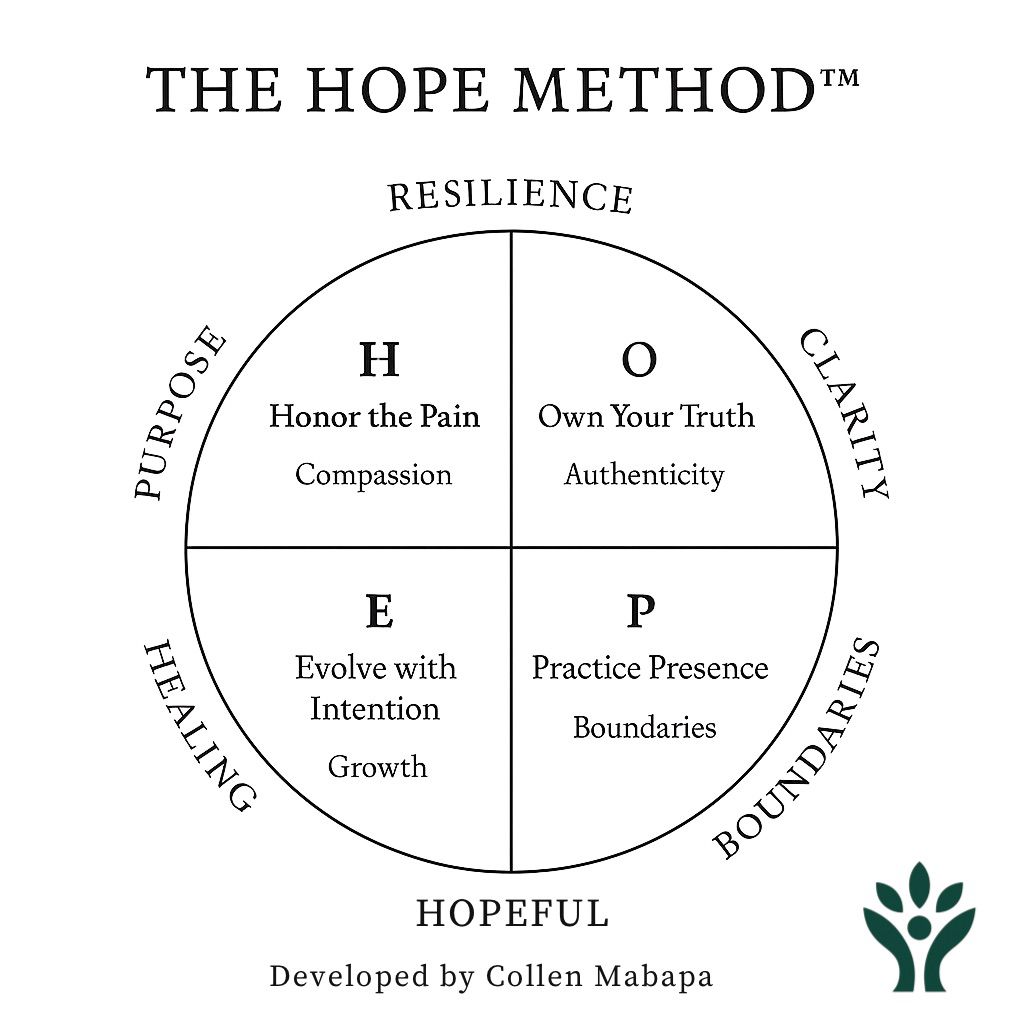
Acknowledge and validate difficult emotions without suppression or avoidance. This pillar teaches you to process emotional data as information rather than threats, restoring your capacity to respond rather than react.
Key Practices:
- Name the emotion without judgment
- Validate your experience as real and important
- Resist the urge to suppress or bypass pain
- Process emotions as data, not identity
Align your internal story with reality through honest self-assessment. This pillar focuses on maintaining boundaries hygiene—knowing where you end and others begin—and ensuring your narrative matches your lived experience.
Key Practices:
- Identify misalignments between story and reality
- Set and maintain clear boundaries
- Take responsibility for your part in situations
- Speak your truth with clarity and courage
Ground yourself in the present moment to regulate your nervous system and restore capacity. This pillar emphasizes somatic awareness and the connection between body and mind in maintaining psychological alignment.
Key Practices:
- Use breathwork to regulate your nervous system
- Engage in somatic practices (movement, grounding)
- Notice when you're stuck in past or future
- Return attention to the present moment repeatedly
Integrate insights and take purposeful action to sustain long-term growth and resilience. This pillar transforms understanding into behavior, ensuring that learning leads to lasting change rather than temporary motivation.
Key Practices:
- Translate insights into specific actions
- Design experiments to test new behaviors
- Track progress and adjust based on feedback
- Build systems that support sustained change
HOPE System Failure Patterns
Understanding how the system fails transforms The HOPE Method™ from a growth tool into a diagnostic-grade framework. These predictable patterns allow facilitators to intervene with precision before complete collapse occurs.
This pattern begins when an individual suppresses difficult emotions (failing H - Honor the Pain). The suppressed emotional data distorts cognitive processing, leading to confusion (failing O - Own Your Truth). As cognitive load increases, the nervous system becomes dysregulated, leading to exhaustion and boundary collapse (failing P - Practice Presence). Finally, the individual loses connection to purpose (failing E - Evolve with Intention).
Observable Symptoms:
- "I don't feel anything anymore" (H failure)
- "I don't know what's real" (O failure)
- "I'm exhausted all the time" (P failure)
- "I don't know who I am anymore" (E failure)
Intervention Point:
The earliest intervention is at H (Honor the Pain). Guided emotional identification exercises can prevent the cascade. If caught at O, narrative clarification through journaling can stabilize the system before physical collapse.
This pattern begins when an individual avoids acknowledging an uncomfortable truth about themselves, their relationships, or their circumstances (failing O - Own Your Truth). The avoidance creates a gap between their internal narrative and external reality, leading to identity confusion (failing E). To maintain the false narrative, they over-accommodate others and erode their boundaries (failing P). Eventually, the emotional cost becomes unbearable (failing H).
Observable Symptoms:
- "I'm fine, everything is fine" (O failure)
- "I don't know what I want anymore" (E failure)
- "I can't say no to anyone" (P failure)
- "I'm overwhelmed and resentful" (H failure)
Intervention Point:
The earliest intervention is at O (Own Your Truth). Structured truth-telling exercises (journaling, trusted conversations) can break the avoidance pattern. If caught at E, values clarification work can restore identity coherence.
This pattern begins when an individual lives primarily in the past or future, unable to ground in the present moment (failing P - Practice Presence). The lack of grounding leads to decision paralysis and mental fog (failing E). Without clarity, they lose track of their own story and reality (failing O). Eventually, they become emotionally numb and disconnected (failing H).
Observable Symptoms:
- "I can't focus on anything" (P failure)
- "I don't know what to do" (E failure)
- "I don't recognize my own life" (O failure)
- "I feel nothing" (H failure)
Intervention Point:
The earliest intervention is at P (Practice Presence). Somatic grounding practices (breathwork, movement) can restore nervous system regulation. If caught at E, breaking decisions into smaller, present-moment actions can rebuild capacity.
This pattern begins when an individual knows what to do but fails to act (failing E - Evolve with Intention). The gap between knowing and doing erodes their sense of purpose and self-trust (failing H). To cope with the dissonance, they distort their narrative to justify inaction (failing O). Eventually, they suppress the emotional pain of stagnation (failing H).
Observable Symptoms:
- "I know what I should do, but I don't do it" (E failure)
- "What's the point anyway?" (H failure)
- "I'm actually fine where I am" (O failure)
- "I don't feel anything about it anymore" (H failure)
Intervention Point:
The earliest intervention is at E (Evolve with Intention). Micro-action experiments (tiny, low-stakes steps) can break the inaction pattern. If caught at H, reconnecting with the original purpose/pain can reignite motivation.
Why This Matters: These failure patterns are observable, measurable, and reversible when caught early. Recognizing the pattern allows for targeted intervention rather than generalized support. This is what makes The HOPE Method™ clinical-grade and certifiable for professional facilitators.
How the Four Layers Work Together
The four layers are not separate—they're nested and complementary. Layer 1 provides the behavioral foundation that everyone can practice. Layer 2 explains the internal systems those behaviors regulate.Layer 3 enables diagnostic precision by mapping behaviors to specific intelligences.Layer 4 deepens the practice through 21 trainable skills of Spiritual Intelligence, making the method certifiable and scalable for mastery-level facilitators.